In Rosewood Park, a disagreement over two shutter colors has turned into a larger question: When a homeowner receives written approval, can they rely on it?
According to two posts shared by a resident in the neighborhood Facebook group, their exterior paint request was approved on September 22. With approval in hand, they booked a painter, paint was purchased, and the project was scheduled.
Then came the reversal.
The homeowner reports that Heritage received approvals on September 21, followed by a denial the next business day. However, they say the denial did not reach them until September 28—six days after they received the approval and after arrangements for the work were underway.
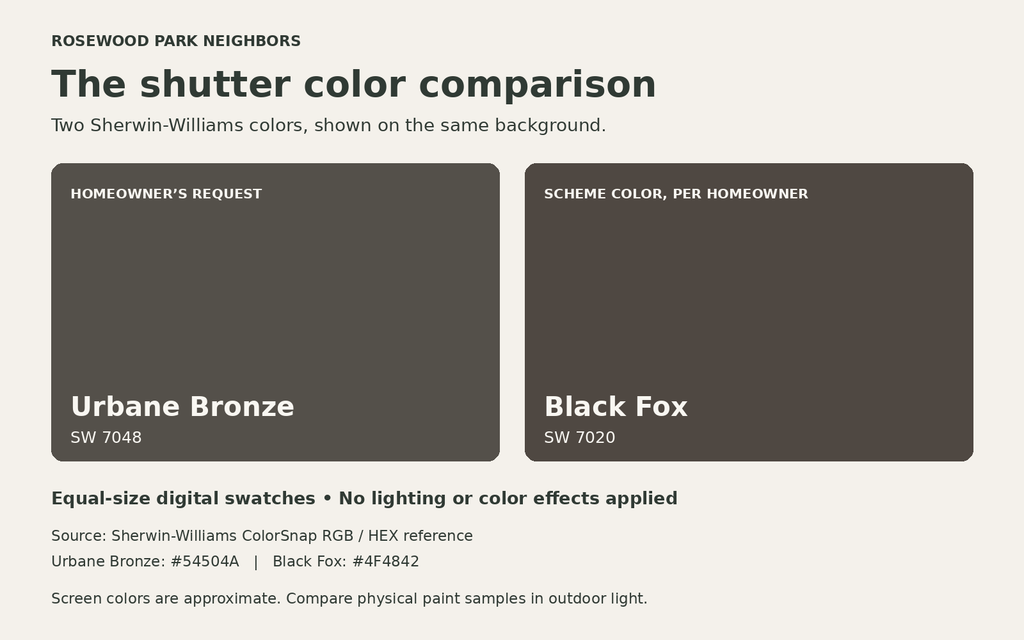
The disagreement involved a request to use Urbane Bronze shutters instead of Black Fox with Scheme 12. According to the homeowner, both colors appear in approved schemes, but the requested combination crosses scheme boundaries.
They explained that Urbane Bronze would better complement the warm tones of their home’s stonework and more closely resemble its existing appearance.
Two dark neutral colors. One surprisingly complicated neighborhood production.
An Approval With an Asterisk?
In a follow-up post, the homeowner said the Board upheld the denial after considerable back and forth. Describing their frustration with the exchanges surrounding the decision, they wrote:
“And instead of being genuinely understanding and acting as humans, it was as if speaking to robots.”
They also questioned the explanation that the approval was merely a notification sent in error by property management:
“Even though we received an approval that looks, walks, and talks like an approval – it’s not a real approval, it was simply only a ‘notification’ that was sent in error by the property management.”
According to the homeowner, that explanation extended to the mailed letter:
“Even the letter via mail was just a notification that specifically states approval for our requested project.”
That leaves residents with a practical question: What must an approval say—or who must send it—before it actually counts?
Homeowners hire contractors, purchase materials, and arrange schedules based on these communications. If a message is preliminary, it should clearly say so. If it communicates final approval, residents should have confidence that the review process is complete.
Calling an approval a notification after the fact does little to help someone who has already acted on it.
The Color Question
According to the homeowner, the Board explained that substitutions could be made only using colors within the selected scheme.
A community can establish coordinated paint schemes. Residents also deserve a clear explanation of how requests for variations are evaluated, including whether an approved color from another scheme can be considered on its merits.
The homeowner raised a reasonable design question: Does choosing another color from within the same scheme necessarily produce a better match than choosing a similar neutral from another approved scheme?
That question deserves an explanation connected to the home’s appearance and the applicable standards.
At the time of writing, two other neighbors have expressed similar concerns about shutter-color restrictions. One reported choosing to remove their shutters altogether because the permitted color in their selected scheme did not complement the stonework on their home.
These additional accounts do not, by themselves, establish inconsistent treatment. They do suggest that the challenge of matching approved paint schemes to existing materials extends beyond a single household.
When a homeowner chooses to remove shutters rather than paint them an unsuitable color, it is worth asking whether rigid scheme boundaries are achieving the intended architectural harmony. That question deserves an explanation connected to the home’s appearance and the applicable standards.
What Do Our Governing Documents Say?
Rosewood Park’s governing documents provide a framework for architectural decisions. The Bylaws establish the committees, while the Declaration describes their architectural review authority.
The Bylaws, Article III, Part D, Section 1 (printed page 9), require the Board to establish a New Construction Committee and a Modifications Committee to maintain appearance standards as provided in the Declaration.
The Declaration, Article XII, Section 2(b) (printed page 22), states that after the community has been fully developed and conveyed to owners, the Modifications Committee has “exclusive jurisdiction over modifications, additions or alterations” to existing structures. That provision also reserves a veto to the New Construction Committee for actions it determines are inconsistent with its guidelines.
Article XII, Section 3 (printed page 23), directs homeowners to submit plans—including proposed colors—to the Modifications Committee for approval. It gives the committee authority to approve or disapprove applications based on workmanship, design, and harmony with existing structures.
That section also provides a 50-day decision period after all reasonably requested information and materials are submitted. Applications are deemed approved if the relevant committee fails to act within that period, but the Declaration also states that express or deemed approvals cannot be inconsistent with the Design Guidelines unless the required written variance has been granted.
The newer Design Standards, Sections D.2 and D.4 (page 5), describe an additional Board review before the final decision is communicated. For routine approvals, they state that property management communicates approval after the ACC determines the request complies and the Board concurs.
Section D.3 (page 5) expressly states that the Declaration and Bylaws control if a conflict exists.
These provisions raise two questions worth explaining to residents: How does the newer Board review requirement fit with the committee authority described in the Declaration, and why was an approval communicated before any required review was complete?
The documents alone do not establish whether this homeowner’s approval was valid or whether a variance was required. That would require reviewing the application, correspondence, and applicable color requirements. However, the newer standards describe a process in which review occurs before the final decision is communicated to the homeowner.
A Process Worth Reviewing
The homeowner also expressed concerns about inconsistent explanations and fairness. Those concerns reflect their experience; the posts alone do not establish that other applications were treated differently.
The reported timeline does identify several questions worth answering:
- Who confirms the final decision before Heritage sends an approval?
- Why did the homeowner reportedly receive the denial several days after it was issued?
- What happens when a resident schedules work or purchases materials based on an approval sent in error?
- What criteria guide requests to combine colors from different approved schemes?
- How are the respective roles of the ACC, Board, and property management explained to homeowners?
A dependable process benefits everyone: residents, committee volunteers, Board members, and property management.
If conflicting decisions were communicated, that is an opportunity to identify what went wrong and correct it. It is also an opportunity to consider a practical resolution for the resident caught in the middle.
Rosewood Park’s architectural review process should help neighbors improve their homes while maintaining community standards. Ideally, choosing between two dark shutter colors should involve fewer procedural mysteries than closing on the house itself.
The larger issue is confidence that written decisions mean what they say.
Disclaimer: This article summarizes and quotes a homeowner’s two Facebook posts and includes editorial commentary. The governing-document references are drawn from the supplied 2006 Bylaws and Declaration and the Design Standards marked effective January 1, 2026. The homeowner’s application, approval and denial correspondence, and applicable paint-scheme requirements were not independently reviewed. No direct response from the Board or Heritage was provided for this article. This article does not determine the legal validity of the approval, denial, or newer review procedures. The accompanying cartoon is satire and depicts a fictional scene; it does not establish how the ACC voted on this request. Rosewood Park Neighbors is an independent community website and is not affiliated with or endorsed by the Rosewood Park HOA or its management company.